
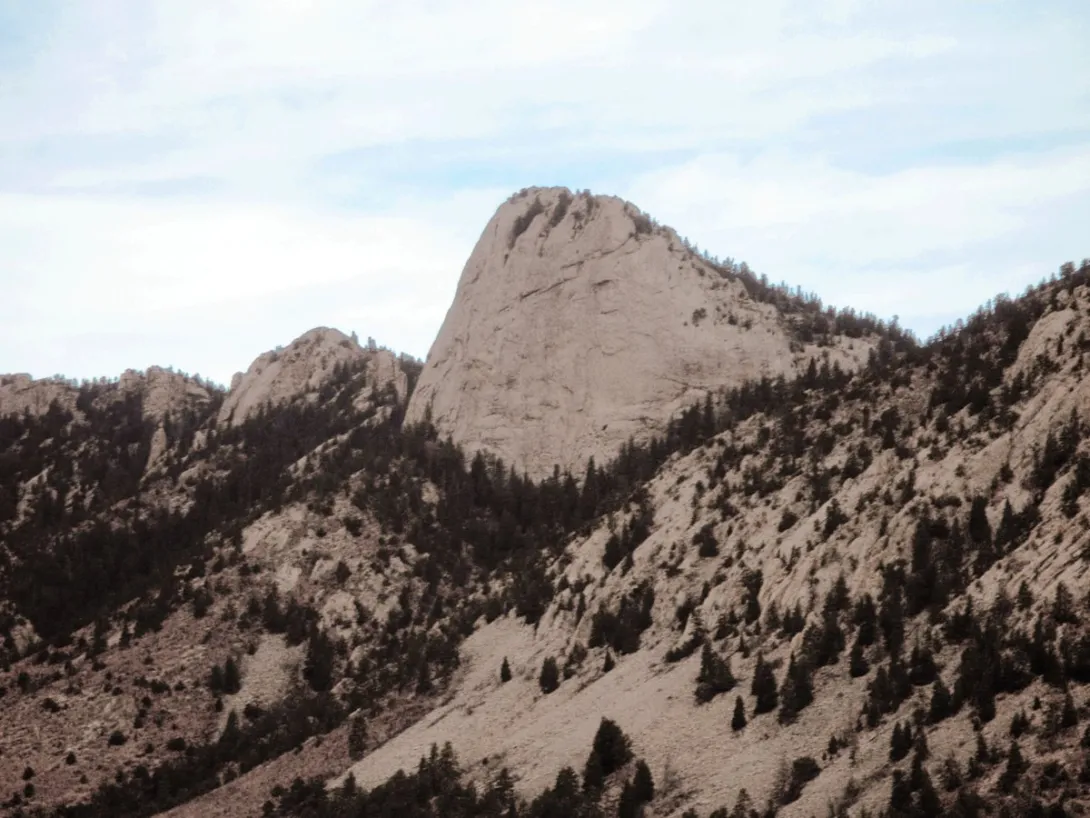
Drive east from Red River over Bobcat Pass, drop into the Moreno Valley, and keep going past Eagle Nest and Cimarron, and the Enchanted Circle brings you to one of the most generous gifts in New Mexico history. On the plains below the Sangre de Cristo Mountains stands the Tooth of Time, a pale rock monolith that rises about 500 feet from its ridge at 9,003 feet. Travelers on the Santa Fe Trail knew it well in the mid-1800s: once they had passed the Tooth, they had only about a week of travel left before they reached Santa Fe. Below that landmark spreads Philmont Scout Ranch, near the village of Cimarron — at about 140,000 acres today, the largest youth camp in the world.
Click to see more photos of Philmont Scout Ranch — the Tooth of Time, the Villa Philmonte, and the ranch country near Cimarron »
The land itself was old grant country long before it was a Scout ranch. In 1841 Carlos Beaubien and Guadalupe Miranda received a large Mexican land grant that included the present ranch, and the grant soon passed to Beaubien's son-in-law, Lucien Maxwell — the same Maxwell whose name runs through the Elizabethtown and Baldy Mountain gold stories told here in recent weeks. Gold was found on Baldy Mountain in 1866, on ground that is now Philmont's northwest boundary, and scores of mines were worked there into the early twentieth century. Baldy, at 12,441 feet, is still the highest point on the ranch.
The modern story begins with Tulsa oilman Waite Phillips. Phillips and his wife Genevieve began buying up pieces of the old grant in 1922, and by 1932 they owned some 300,000 acres. They called the ranch Philmont — Phil for Phillips, and mont from monte, the Spanish word for mountain. Their summer home, the Villa Philmonte, was begun in early 1926, and the family was moving in by June of 1927. Built in Spanish Mediterranean style, the villa came with a guest house, staff quarters, a caretaker's cottage, a greenhouse, and a garage, and the working ranch around it ran cattle, sheep, goats, horses, and bison.
Phillips sometimes let Boy Scout troops visit, and he was so impressed with them that in 1938, in the depths of the Great Depression, he gave Scouting 35,857 acres north of Cimarron. By the summer of 1939 the gift was open as Philturn Rocky Mountain Scout Camp — Phil for Phillips again, and turn for the Scout reminder to do a good turn daily. In 1941 Waite and Genevieve Phillips gave again, adding more than 91,000 acres of mountain country south of Cimarron, including the Villa Philmonte itself, for a total of 127,395 acres. Phillips suggested the villa might serve as a training center, and it did — the Philmont Training Center grew from that idea, and the villa is a house museum today.
Did you know Philmont also keeps a link to another story told here just days ago? The Seton Memorial Library and Museum at Philmont is named for Ernest Thompson Seton, the naturalist whose 1894 hunt for the wolf Lobo, King of Currumpaw, changed his life — and a pelt long identified as Lobo's is kept there. Generations of young people have now backpacked under the Tooth of Time, over Baldy, and through the old mining camps, learning the same mountains that drew Maxwell's miners and Phillips himself. It is the Enchanted Circle's eastern anchor: a mountain an oilman loved so much that he gave it away so other people's children could know it too.