Drive south from Red River around the Enchanted Circle, through Questa and down the Rio Grande gorge, and the road brings you to Taos, the southern anchor of the loop. About a mile north of the modern town stands Taos Pueblo, a living village whose people have called this valley home for a thousand years. It is not a ruin and it is not a museum. Families still live in its adobe houses, worship in its church, and draw water from the creek through its heart.
Click to see more photos of Taos Pueblo — its north and south houses, its church, and Red Willow Creek
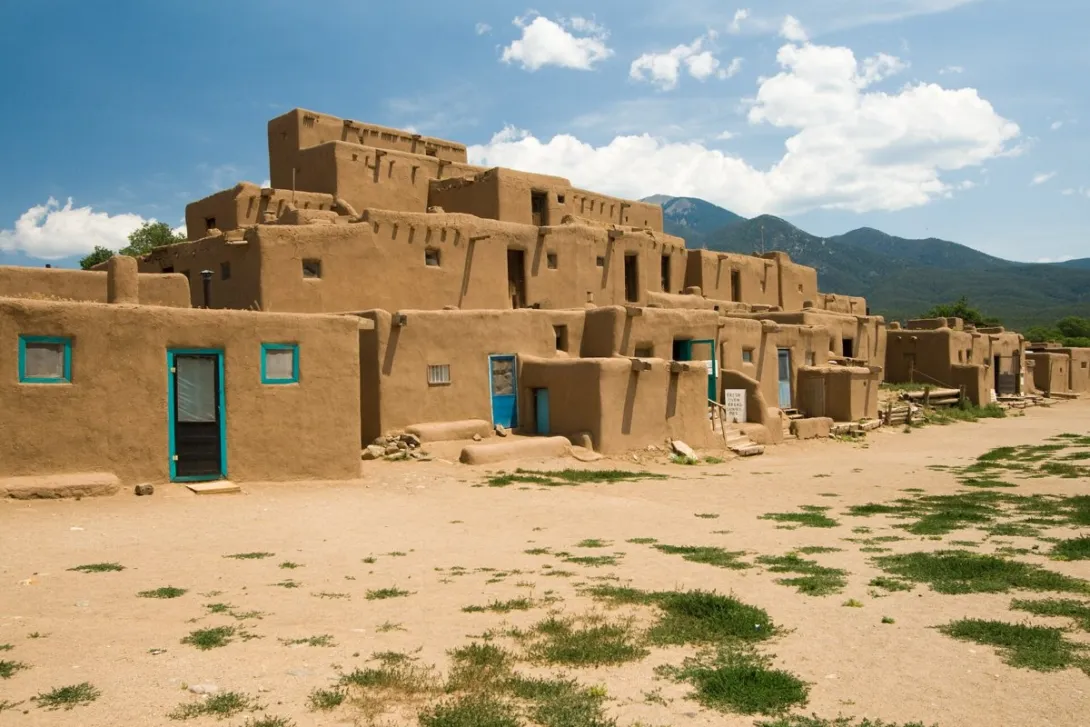
The village is built on either side of the Rio Pueblo de Taos, also called Red Willow Creek, a small stream that flows down from the Sangre de Cristo Mountains. On its banks rise the two great houses, Hlauuma, the North House, and Hlaukwima, the South House, built between 1000 and 1450 and stacked four and five stories high. Their walls, thick at the base and thinner at the top, are still refinished each year with a new coat of adobe plaster as part of a village ceremony. The first rooms had few windows and no ordinary doorways, so people climbed long wooden ladders and entered through holes in the roof. About 150 people still live full time in the historic houses, without electricity or running water, in homes that the Pueblo says are passed down from one generation to the next.
Long before the Circle was a scenic drive, Taos Pueblo was a center of trade. Each fall after the harvest it hosted a trade fair that drew Rio Grande villagers and Plains peoples alike, and trade routes later tied it south to New Spain and Mexico. The first Spanish visitors arrived in 1540 with the Coronado expedition, searching for the rumored Seven Cities of Gold, and one of them described adobe houses stacked five or six stories high. The Pueblo's own history recalls that the mica in its clay glittered in the light, which helped feed that golden misunderstanding. Spanish priests oversaw the first San Geronimo church around 1620, and the ruins and bell tower of the early church still stand inside the walls, while a later San Geronimo church, built in 1850, still serves the community.
The creek that divides the village begins at Blue Lake, high in the mountains the Taos people hold sacred and regard as the place their people originated. In 1906 the United States took Blue Lake and 48,000 surrounding acres into the Carson National Forest, and the Pueblo spent 64 years pressing for its return, arguing that free access to the lake was necessary to its religious life. On December 15, 1970, President Richard Nixon signed Public Law 91-550, returning the lake and the land to Taos Pueblo in trust. It was the first time the federal government restored land to a tribe rather than offering money instead, and the Pueblo names the reacquisition of Blue Lake as the most important event in its history.
That endurance is now recognized around the world. Taos Pueblo was designated a National Historic Landmark on October 9, 1960, and a UNESCO World Heritage Site in 1992, and the National Park Service calls it the only World Heritage Site in the United States cited for the significance of its traditional Native American living culture. A sovereign tribal government governs the Pueblo, whose lands cover about 95,000 acres. For a Red River visitor finishing the Circle, go slowly and remember whose home you are in: a community that has kept its language and ceremonies, and lived in the same houses for a thousand years.