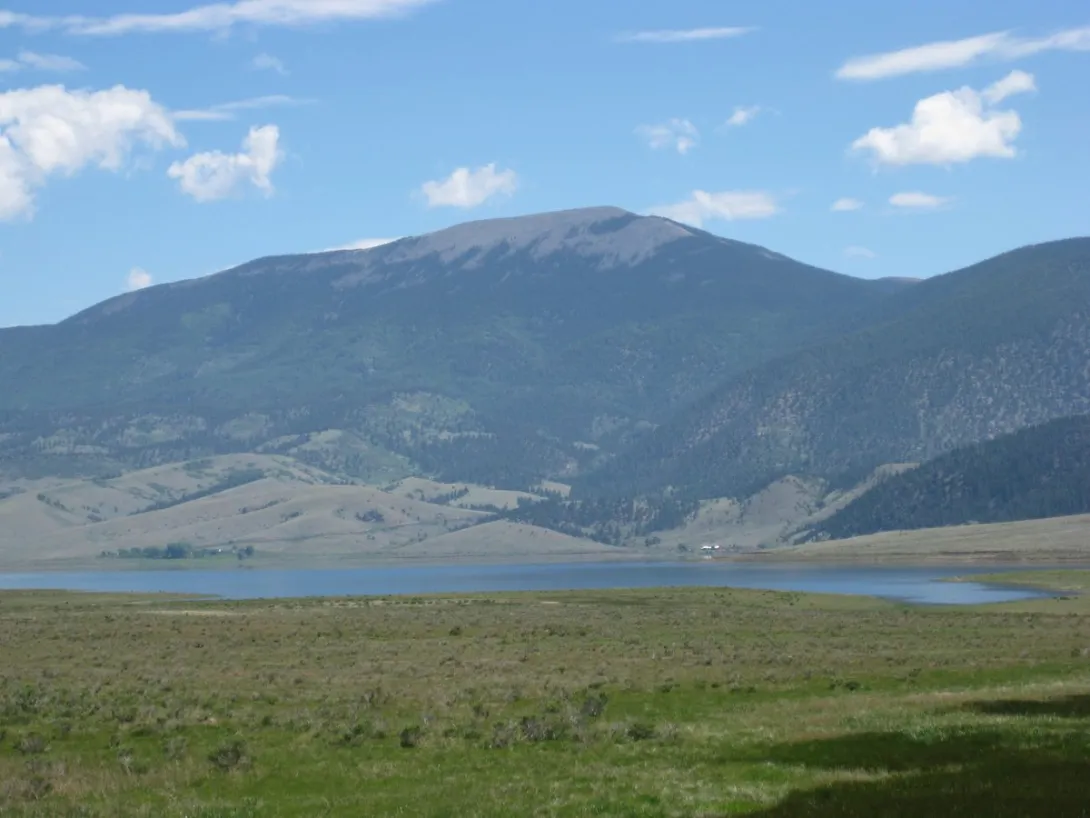
Drive south from Red River on NM 38, over Bobcat Pass, and the trees open onto the wide Moreno Valley. At the north end of a blue alpine lake, where US 64 meets NM 38, sits the village of Eagle Nest, at 8,216 feet, with just 315 residents in the 2020 census. Did you know it was not always called Eagle Nest? The settlement was first known as Therma, and it was only renamed Eagle Nest in the 1930s, after the dam and lake that changed everything here.
Click to see more photos of Eagle Nest Lake
Long before there was a lake, this valley was a crossroads. Ute and Jicarilla Apache people roamed the Moreno Valley in search of game and golden eagle feathers for ceremonial use. When Elizabethtown, just five and a half miles north, boomed with gold, the Eagle Nest area stayed quieter, given over mainly to ranching and farming. In 1873, brothers Charles and Frank Springer founded the C.S. Ranch on the banks of the Cimarron River, laying the foundation for what came next.
In 1907 the Springers were granted a permit to dam the Cimarron River, and after years of planning, construction ran from 1916 to 1918. The finished Eagle Nest Dam, 140 feet high and 400 feet across, was the largest privately built dam in the United States. The new lake was soon stocked with trout, and the fishermen arrived. Entrepreneurs followed, building businesses that transformed a quiet farming community into a small tourist mecca for fishermen, cowboys, and travelers passing through the Enchanted Circle.
Winter brought its own industry. Crews hired by T. D. Neal drove out onto the frozen lake to cut block ice, stored in ice houses packed with sawdust, and many local families got through the cold months by ice cutting and trapping. Neal also started an annual fish fry to promote the lake, drawing two to three thousand winter-weary visitors from across the region. In 1927 Oklahoma oilman Walter Gant hired William B. Tyer to oversee construction of the grand Eagle Nest Lodge, a 12-room resort with a lounge and restaurant, offering fishing, hunting, and horseback riding beneath its view of the lake.
The 1920s and 1930s gave Eagle Nest a wilder reputation. Gambling, illegal at the time, flourished in its saloons and hotels, drawing politicians and travelers on the road between Santa Fe and the horse races at Raton. The El Monte Hotel, later the Laguna Vista Lodge, was among the places said to offer roulette, gaming tables, and slot machines. That era ended with a bust in the late 1940s, when authorities took axes to the slot machines. Local legend, repeated ever since, says some owners heard the raid was coming and dumped their machines in the lake, where old-timers claim they can still be glimpsed in low water.
The state purchased Eagle Nest Lake in 2002, and it is now Eagle Nest Lake State Park, known for kokanee salmon and rainbow trout. The village that began as Therma is a laid-back, less-than-a-mile-long Main Street of shops, lodges, and saloons, still home to the fall Fish Fest that grew from Neal's fish fry. Next time you drive the Enchanted Circle between Red River and Angel Fire, slow down at the north end of the lake. Eagle Nest is proof that a new name, and a new lake, can remake a town.