
Drive south from Red River through the Enchanted Circle and down toward Santa Fe, and the country keeps telling the same story in different colors. Gold drew miners to Red River, quartz veined its caldera hills, and farther south, in a low range called the Cerrillos Hills, people have prized a sky-blue stone for more than a thousand years. That stone is turquoise, and New Mexico is one of the classic places on Earth to learn its story.
Click to see more photos of turquoise
Turquoise is a hydrated phosphate of copper and aluminum, and it is a secondary mineral, which means it formed after the rocks around it. As water moved through copper-bearing, aluminum-rich rock, turquoise grew in fracture zones as nodules and narrow veinlets. The New Mexico Bureau of Geology and Mineral Resources describes the Cerrillos deposits cutting intrusive and volcanic rocks that were strongly bleached by hydrothermal alteration. Copper gives the stone its famous blue, while iron can shift the color toward bluish green and green, so one district can produce pale blue, bright blue, and green stones side by side.
The center of the Cerrillos mining district lies about fifteen miles southwest of Santa Fe, and its best-known turquoise deposits clustered a few miles north of Los Cerrillos, on Turquoise Hill and Mount Chalchihuitl. The Bureau of Geology notes extensive prehistoric workings at both places. Pueblo miners were working these hills from about 900 A.D., and the stone they prized traveled widely through the Southwest. Modern miners rediscovered the ancient diggings in the 1880s, production peaked during the 1890s, and the American Turquoise Company made the district famous again in the years around the turn of the century.
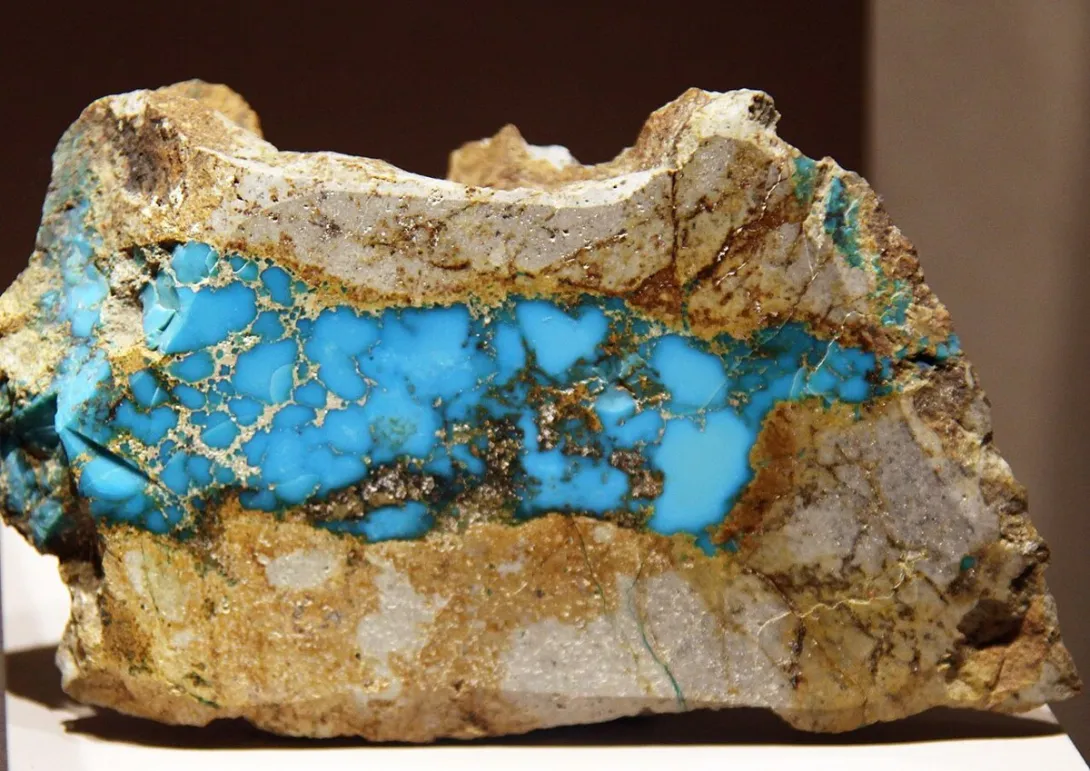
For a rockhound visiting Red River, turquoise is a wonderful teacher even when it stays in a museum case or a shop window in the Enchanted Circle. Look for an opaque stone with a waxy shine, color that deepens and softens across a single piece, and natural matrix, the host rock still clinging to the blue. A vein of turquoise running through pale, altered rock, like the Cerrillos specimen in the Smithsonian collection, shows exactly how the mineral grew in cracks underground. Learning to read that pattern is the heart of rockhounding, whether the stone is blue turquoise or a quartz crystal from our own high country.
Know before you go
This feature names no collecting site, because the historic Cerrillos turquoise mines are not open ground for collecting. Rock collecting and metal detecting are not allowed in Cerrillos Hills State Park, and collecting on an existing mining claim is prohibited without the claimholder's permission, as the Bureau of Land Management explains. On Bureau of Land Management land that is open, rockhounds may collect reasonable amounts of rocks and gemstones for personal use only, with hand tools and only minor surface disturbance, and not in developed recreation sites. Always check land status before you go, respect private land and posted signs, never enter old mine workings, and pack out everything you pack in.