
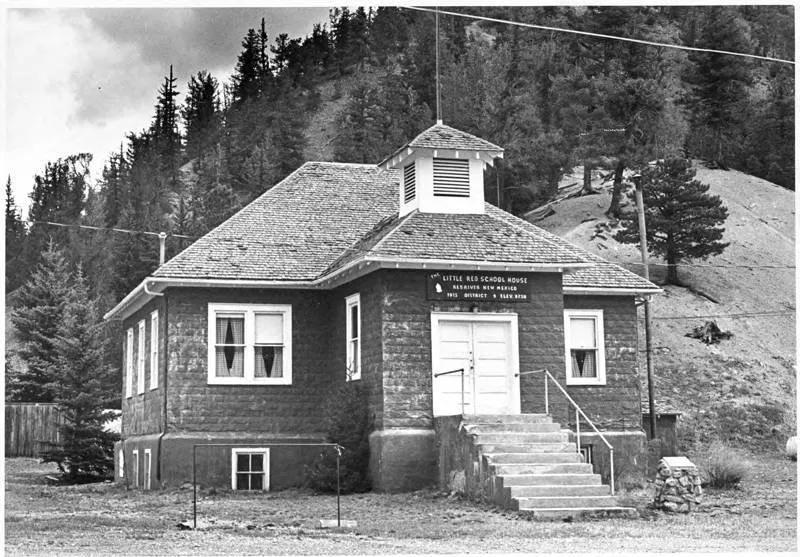
On High Street, on the north edge of town overlooking Red River, stands a small red building with white trim, a hipped roof and a belfry topped by a flagpole. Visitors know it as the Little Red Schoolhouse, and generations of Red River children knew it simply as school. Its one classroom, measuring 30 feet by 24 feet, could seat 40 pupils, and for nearly three decades that single room held the whole of the town's public education, with an 11-foot-square vestibule that served as a cloakroom to keep cold, damp wraps out of the study room.
The schoolhouse was not the first building on its site. According to its National Register of Historic Places nomination, the first school in Red River was a log structure erected soon after Red River City was platted in 1895, on the same site, and it was destroyed by fire. The present building followed after School District No. 25 issued 3,000 dollars in bonds on July 1, 1914. The carpenter was Ed Wheatcroft, who had come to Red River from Manassa, Colorado and was remembered for his long white beard. Local tradition says that miner-citizens, including the Mallette brothers and Edward Westoby, helped to build the schoolhouse, and that residents donated the land, along with some labor and materials.
Its appearance tells a mining-town story of its own. The frame walls are clad in pressed metal formed to imitate rusticated stone blocks, the same siding used on the Red River Miners' Hospital, and the nomination calls the building an example of a public building that reflects the short-lived period of mining prosperity in Red River. Old photographs show that it was originally painted white, before it took on the red paint that gave it its familiar name. Its design strongly resembles Design No. 2 for a one-room frame building in the 1909 Designs and Specifications for New Mexico Public School Buildings, prepared for the territorial Department of Education.
The schoolhouse was also far more than a school. Because the community had no church, it served as a church on Sundays, when traveling preachers of various denominations gave sermons in the classroom. In summer, square dances were held in the schoolhouse every week to the music of fiddles, banjos, mandolins and guitars. A long blackboard stretched across the north wall on school days, but the room belonged to the whole town, for learning in the week, worship on Sunday and dancing when the summer evenings came.
In 1939, the Works Progress Administration funded a raised concrete basement beneath the building, providing space for a furnace and living quarters for the teacher, under the supervision of L. S. Lewis of the Lewis Ranch. The schoolhouse ceased to be used as a school in 1942, and the Red River Women's Club maintained it afterward. It was entered in the New Mexico State Register of Cultural Properties on December 1, 1982, and listed in the National Register of Historic Places on February 23, 1984, as part of the Red River Multiple Resource Area. Today it serves as the home of the Red River Historical Society museum, where the town's photographs and artifacts are kept, and in the spring of 2000 Lottie Tweed planted the Aunt Becky Coffelt Memorial Garden beside it, so that the little red building still teaches Red River's story to everyone who stops to look.