
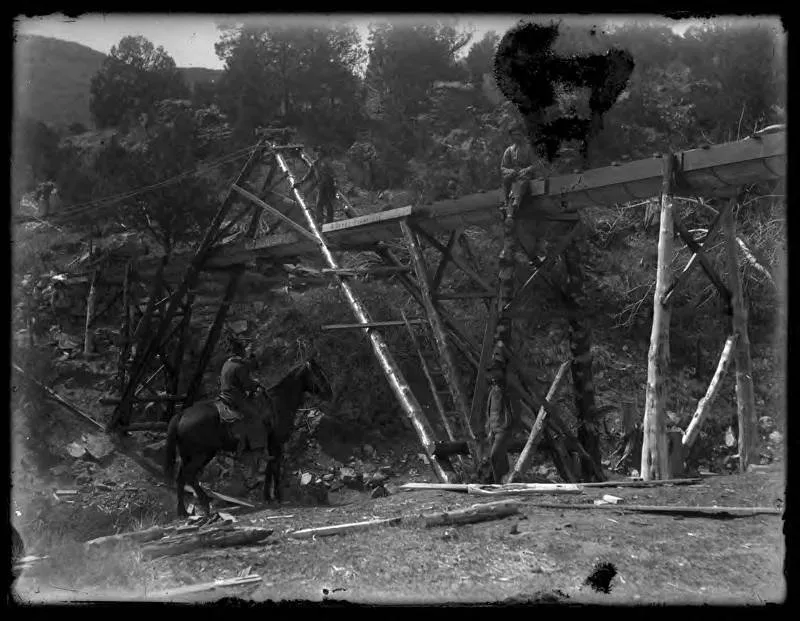
Drive the Enchanted Circle north of Eagle Nest today and Elizabethtown looks like a quiet ghost town below Baldy Mountain, but in the summer of 1901 it hosted the most ambitious machine the New Mexico gold fields had ever seen. The Oro Dredging Company, led by its president, H. J. Reiling of Chicago, christened a giant floating dredge the Eleanor that August and set her to work on the placer gravels of Moreno Creek. A territorial history published in 1907 called her the only mining dredge in operation in New Mexico, and her enterprise unique in the history of mining in the territory.
Click to see more photos of the Eleanor dredge and Elizabethtown — including the dredge herself at work in Moreno Creek »
Elizabethtown had been waiting decades for such a machine. Founded in 1866 after gold was panned from Willow Creek, it became New Mexico's first incorporated town, and its placers were famously rich — Spanish Bar and the ground just below it were considered the richest in the camp, and single gulches yielded more than a hundred ounces of gold in a week. What the camp always lacked was water and an efficient way to work its gravels. The 41-mile Big Ditch, built to carry Red River water to the placers, leaked most of what it carried, and the first attempts at dredging failed because the plants were, as the 1907 history put it, crude and too light to perform the desired work.
Eleanor was anything but light. Later accounts describe her hauled piece by piece from the railhead at Springer over mountain roads and streams, with a dam built three miles from town so the biggest pieces could be floated in on a large boat. Her machinery alone weighed 350,000 pounds, and her 65 buckets dug 22 feet into the earth, and as much as 50 feet through high gravel banks. She began work on the creek about two and a half miles below Elizabethtown and, as she worked her way upstream, she made her own body of water to float in, ending up nearly opposite the old camp. She ran in the spring, summer, and fall, when mountain weather allowed.
The results justified the effort. Eleanor could handle up to 4,000 cubic yards of dirt a day, and an electric plant aboard let her run 24 hours continuously, recycling her sluice water as she went. The gravel she chewed through carried from thirty cents to three dollars in gold per cubic yard, and in her first year of operation she cleared over 100,000 dollars — about one-quarter of all the gold produced in New Mexico that year. Reiling knew the business well: the same history credits him as a pioneer of the method who had introduced the first dredge into the gold fields of Montana.
Her reign was brief. A fire in September 1903 gutted much of Elizabethtown, and at about the same time, later accounts say, Eleanor's owner mortgaged her to finance a similar venture in Colorado. The following year was unprofitable, bankruptcy followed, and the dredging operation finally died in 1905. Eleanor was left to rust and sink into the sands of Moreno Creek, where her buried remains still lie, with no trace visible today. The Moreno Valley went on to produce five million dollars in gold over 75 years, most of it in the first 40, but no single machine ever matched the summer a 350,000-pound dredge dug her own pond below a ghost town and paid for herself in a single season.