
Drive east out of Red River over Bobcat Pass and the Moreno Valley suddenly opens wide in front of you, and there, spread across the valley floor, is a sheet of blue water ringed by pasture and peaks. Did you know that Eagle Nest Lake is not a natural lake at all? A little more than a century ago there was no lake there, only the Cimarron River winding through ranch country, until two ranching brothers decided to dam it and change the eastern side of the Enchanted Circle forever.
Click to see more photos of Eagle Nest Lake — a lone fisherman, Wheeler Peak from Eagle Nest, and sunrise on the lake
The brothers were Frank and Charles Springer, who had founded the C.S. Ranch on the banks of the Cimarron River in 1873. In 1907, the Springers and the Cimarron Valley Land Company were granted a state water permit to impound the river for irrigation. The idea was ambitious for a private ranching outfit: store the surplus and flood waters of the Cimarron behind a dam in the mountains, then release that water to farms and ranches in eastern Colfax County. The National Park Service, in listing the dam years later, noted that the project was designed to irrigate more than 40,000 acres.
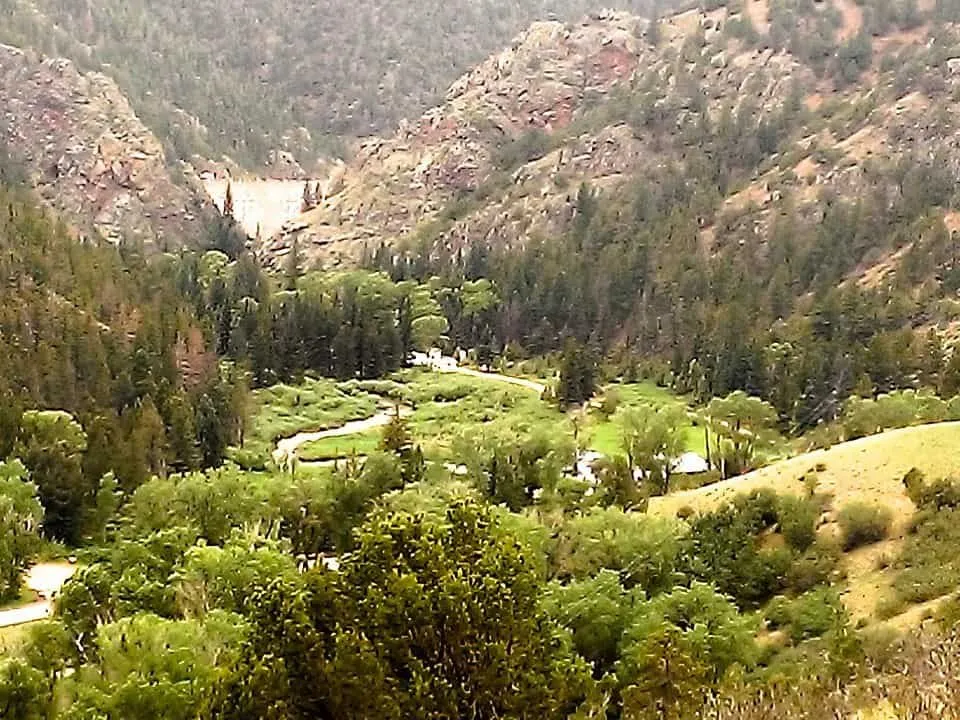
Construction began in 1916, with Willis Ranney as chief engineer, and most of the labor was provided by workers from Taos Pueblo. What rose between two granite walls at the mouth of Cimarron Canyon was a graceful concrete arch: 140 feet high above the riverbed, 400 feet long along its curve, just 9.5 feet thick at the crest and 45.2 feet thick at its base. It was considered the largest privately built dam in the United States, and building it even meant rerouting U.S. Route 64 to its present course over McAvoy Hill. In 1918 the river was impounded and the lake was born. The story goes that eagles made themselves at home on the sides of the new dam, and that is how Eagle Nest got its name, a name the nearby village, first called Therma, later took for its own.
To help pay for the dam, Springer sold water rights to farmers and ranchers, and those original rights are still known as vested rights. Eagle Nest water still does the job it was stored for, moving down the Cimarron River and a system of canals to irrigators as far as 50 miles downstream, while towns including Raton and Springer, and the villages of Angel Fire, Eagle Nest, and Cimarron, have since bought rights of their own. The dam was added to the National Register of Historic Places on April 18, 1979. In 2002 the State of New Mexico bought the lake, which is now operated by the Interstate Stream Commission, and on July 3, 2004, Eagle Nest Lake became a state park.
Today, Circle travelers meet the lake first as scenery, and it is easy to forget it is a working reservoir. Anglers come for its rainbow and brown trout and kokanee salmon, boaters take to it in summer, and in winter fishermen drill holes in its ice. So the next time you roll down from Bobcat Pass, or up from Cimarron Canyon, and that big blue water flashes into view, remember: you are looking at a ranchers' bold idea from 1916, still holding back a river, still feeding farms downstream, and still one of the loveliest sights in northern New Mexico.