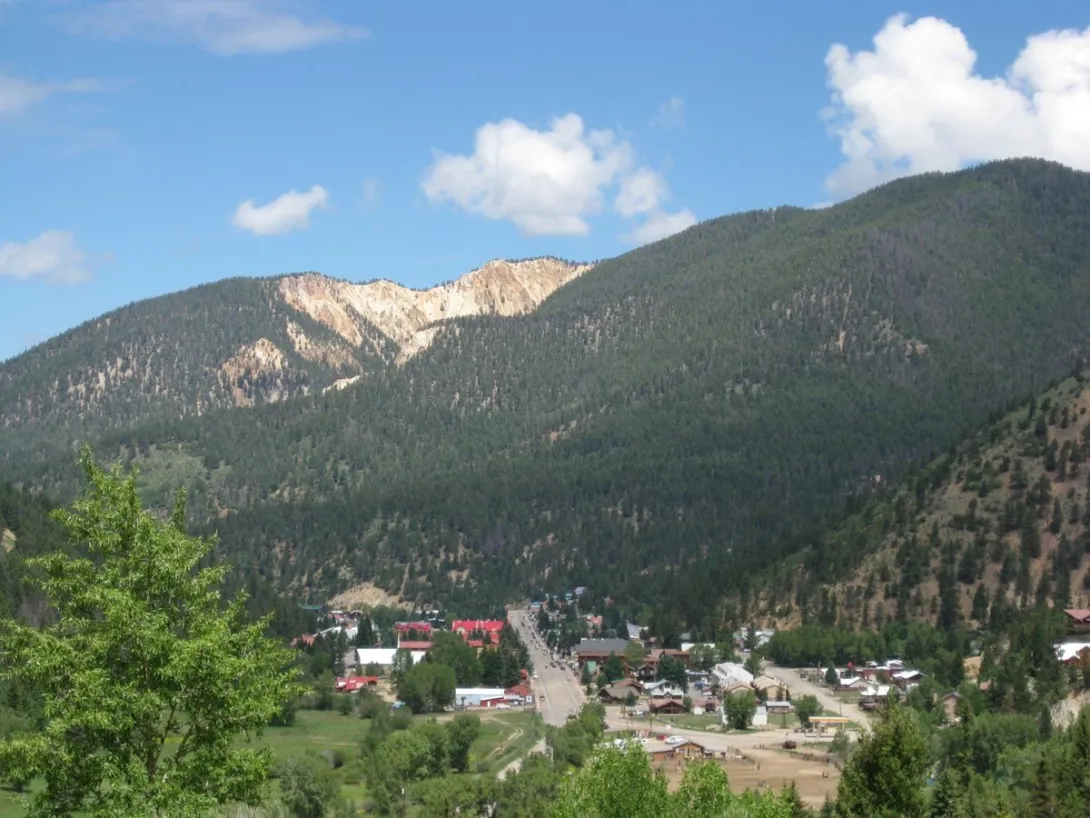
November 3 arrives in Red River in the quiet hinge of the year, with cold mornings, early darkness, and the ski mountain counting down to its late November opening. No Red River event can be honestly tied to November 3 itself, so today the lead story looks four days ahead in the same week of the year. On November 7, 1906, a signature in Washington set apart the forest that still surrounds this town, and that decision shapes every view from Main Street today.
Red River Town & Main Street
For a Main Street story from this month, look ahead to Thanksgiving in 1967, when Texas Reds Steakhouse opened at 400 East Main Street. The New Mexico tourism listing explains that Texas Red was the nickname of the man who built the building that held the restaurant in its original location, and local legend remembers a Texas outlaw of the same name who once traded train robbery loot for a good steak and a bottle of whiskey. The steakhouse has served Red River ever since, through changing owners and changing seasons.
Mining & the Gold Rush
For a mining story tied to this season, remember the fall of 1866, when gold was found along Willow Creek below Baldy Mountain. Prospectors sent from Fort Union followed reports of pretty rocks brought in by a Ute visitor, and their panning touched off the rush that built Elizabethtown, the Moreno Valley boomtown west of Eagle Nest. Within a few years thousands of claims were staked around Baldy, and miners from that first rush later pushed west into the gulches above the Red River, where a second gold camp grew into the town we know today.
Founding Families, Characters & Legends
Here is a same-week story with its real date stated plainly. On November 6, 1875, three days from today, Manuel Cardenas turned himself in at Elizabethtown rather than face a lynch mob. The Methodist missionary Franklin J. Tolby had been shot in Cimarron Canyon on September 14, and the lynched constable Cruz Vega had named Cardenas as the shooter. Cardenas told the justice of the peace that members of the Santa Fe Ring had ordered the killing. He was shot dead in Cimarron on November 10, before he could testify in court, and the mystery was never solved.
Skiing & Winter
Early November has always been a season of preparation in Red River, and this year is no different, with the Red River Ski and Summer Area set to open on Wednesday, November 25. That late November opening continues a long town tradition built around Thanksgiving week. The area first opened in December 1959, when Stokes Bolton and his partners raised lifts built in part from salvaged oil field equipment directly above town. Within a few years Red River was also making snow, among the first ski areas in the Rocky Mountains to do so, so that November cold could be put to work.
Enchanted Circle Towns & Places
Around the Circle in Eagle Nest, the great dam that made the lake is a story of this same building era. Ranchers Frank and Charles Springer and the Cimarron Valley Land Company received their water permit in 1907, and construction on Eagle Nest Dam began in 1916. Built largely by laborers from Taos Pueblo, the concrete arch rose 140 feet high and stretched 400 feet across the Cimarron River. It was described as the largest privately built dam in the United States, and the lake behind it soon drew anglers and turned a farming valley into a mountain getaway.
The Land, Weather & Wildlife
Our lead item belongs here. On November 7, 1906, four days from today, President Theodore Roosevelt signed the proclamation that created the Taos Forest Reserve, setting apart 233,200 acres of timbered public land in northern New Mexico. The reserve became a national forest on March 4, 1907, and on July 1, 1908, it was combined with part of the Jemez forest to form the Carson National Forest. The new reserve also swept in lands around Blue Lake, sacred to Taos Pueblo, and the Pueblo spent the next 64 years seeking their return, which Congress granted for 48,000 acres in 1970.
Roads, Stage Lines & Travel
For a travel story from this season, remember the road meetings held in Red River in late 1913 and early 1914. Mining engineer Norman L. Faris helped organize the neighbors who formed the Good Roads Association, and their crews built the Red River Pass Road in 1915 and 1916. The new road replaced the harrowing Big Hill wagon route and made the valley reachable for ordinary families in affordable automobiles. Those early motorists came for trout, cool air, and mountain scenery, and many of them rented abandoned miners cabins, beginning the visitor trade that sustains the town today.
Living History & Heritage
The forest proclamation of 1906 is not only history, because it is still lived with every day. The Carson National Forest surrounds Red River on every side, and its Questa Ranger District still manages the trails, campgrounds, and ski slopes that visitors enjoy. Above Taos, the 19,661-acre Wheeler Peak Wilderness, first set aside as a wild area in 1960 and designated as wilderness in 1964, protects the headwaters of the Red River and the highest point in New Mexico at 13,161 feet. To hike, fish, or ski here today is to move through the landscape that the 1906 reserve began to protect.
So November 3 in the Enchanted Circle holds a steakhouse that opened at Thanksgiving, a gold rush born in the fall, a witness who surrendered this week in 1875, and a forest reserve signed into being on November 7, 1906. None of those stories needs an invented date to matter. Together they explain why this small town, tucked into its forested valley beneath Wheeler Peak, still feels both wild and welcoming when the November light fades early over Main Street.