
November 13 is a quiet date on the Red River calendar, with no famous gunfight or grand opening attached to it, and that is exactly what makes it worth exploring. When we searched this date hard across the Enchanted Circle, three genuine November 13 moments emerged, in 1821, in 1850, and in 1862, and each one helped shape the world that Red River would later inherit. The other categories today are honest seasonal context for mid-November in the high country, labeled as such.
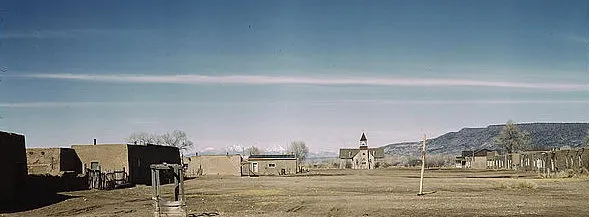
Click to see more photos of Costilla, New Mexico
Red River Town & Main Street
For Red River itself, we found no verified event on this exact date, so this is seasonal context rather than an anniversary. In mid-November, the town first known as Red River City, founded in 1895 and once home to about three thousand people at its mining peak, would have been settling into its hardest season. Main Street stores stocked flour, coal, and lamp oil against the cold, woodpiles grew beside the cabins, and every conversation eventually turned to snow, frozen pipes, and whether the road down the canyon would stay open.
Mining & the Gold Rush
This, too, is seasonal context, because no verified November 13 mine event surfaced for the Circle. Gold was discovered on the western side of the Maxwell Land Grant in 1866, miners rushed to the diggings, and Elizabethtown rose there, becoming the first seat of Colfax County in 1869. By the middle of November in those boom years, the high camps around Baldy Mountain faced a simple truth. Water froze, sluices stopped, and underground work, hauling, and repair became a race against winter that only the most determined miners could win.
Founding Families, Characters & Legends
On November 13, 1850, Bishop Jose Laureano de Zubiria of Durango dated his pastoral letter to the priests of New Mexico, a document rooted in Taos. Zubiria had taught Antonio Jose Martinez in the Durango seminary, and on his first visit in 1833 he gave Padre Martinez permission to begin a pre-seminary at his Taos home for young men preparing for the priesthood. The 1850 letter came twelve days before Jean Baptiste Lamy was consecrated a bishop, at the very moment church leadership in New Mexico was passing from Durango to a new era.
Skiing & Winter
No verified November 13 ski anniversary belongs to the Circle, so consider this the seasonal story of this week in the year. Local lore says skiing first came to this country in the late 1800s, when mail carriers used handmade skis to bring mail to Red River City and other gold mining camps, and a photograph from around 1900 shows a Taos Pueblo man on skis, possibly delivering mail. Generations later, the Red River Ski Area opened in December 1959, and for decades the area has opened around Thanksgiving, which is why mid-November still feels like opening season here.
Enchanted Circle Towns & Places
Our lead item is an exact date. On November 13, 1862, the village then known as San Miguel opened its post office and selected a new name, Costilla, perhaps in recognition of its new status. A year earlier, on November 1, 1861, the new Territory of Colorado had made San Miguel the original seat of Costilla County. Then, in 1869, a federal survey determined that Costilla was actually in Taos County, New Mexico Territory, and on October 21, 1872, its post office was officially renamed Costilla, New Mexico Territory. Costilla, north of Questa on the road toward Colorado, has carried that name ever since.
The Land, Weather & Wildlife
For this category we offer verified seasonal context from the Eagle Nest country, east around the Circle. Ranchers Frank and Charles Springer and the Cimarron Valley Land Company received a permit in 1907 to impound the Cimarron River, and construction of Eagle Nest Dam began in 1916, with about one hundred fifty men at work beginning in late 1916. The finished reservoir took its name from eagles that nested in the area. Builders learned November's lesson the hard way, because severe winter freezes in 1919 and 1920 made it impossible to lay cement during a large part of the year.
Roads, Stage Lines & Travel
Here is another exact date, and a hard one. On November 13, 1821, the Glenn-Fowler expedition, traveling west toward Taos and Santa Fe, first saw the Spanish Peaks in what is now southeastern Colorado. Jacob Fowler kept the party's daily journal, and its roster records that Lewis Dawson was fatally injured by a bear on November 13, 1821, and died on November 16. The expedition reached Taos in January 1822 and then Santa Fe, and Fowler's journal became the first detailed narrative of the southern plains to appear after Zebulon Pike's expedition of 1806 and 1807.
Living History & Heritage
Costilla also carries today's living heritage, because its story was built around plazas that people still recognize. Settler families built their homes around four plazas that defined the original community, among them the Plaza de Arriba, and the village was originally named San Miguel after its church. A 1943 photograph by John Collier Jr., whose image accompanies this article, shows that same plaza world of adobe homes and a church under a wide northern sky. Costilla today is a small Taos County community of one hundred seventy-seven people in the 2020 census, and it still has its own post office.
So November 13 in the Enchanted Circle is a name chosen at a new post office, a bishop's letter written for Taos clergy, and a distant first sight of the Spanish Peaks by travelers bound for Taos. None of it happened on Red River's Main Street, yet all of it belongs to the road, the church, and the mountain country that made Red River possible.